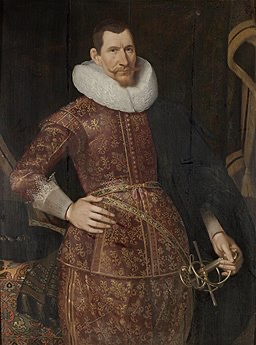
Dutch colonial administrator Jan Pieterszoon Coen (1587 – 1629) born in Hoorn, and was raised in accordance with strict Calvinist principles. In 1601, he travelled to Rome to study trade in Joost de Visscher's offices, where he learned the art of bookkeeping.
After joining the Dutch East India Company (VOC) in 1606, he went east as an assistant merchant in 1607 with Pieter Willemsz Verhoeff's fleet. Verhoeff and many of his men were killed during negotiations with the chiefs of the Banda Islands. Coen submitted a detailed report on trade possibilities in Southeast Asia when he returned home in 1610.
As a result of this report, he was sent overseas again in 1612, this time as the chief merchant. After a successful trade mission to the Moluccas, Coen took over as head of the company's post at Bantam in August 1613. Then, in November 1614, he became director-general, second in command.
Between 1614 and 1618, Coen established Dutch monopolies over cloves from the Moluccas and the Banda Islands’ nutmeg and mace production.
Disputes with the local ruler, the Chinese, and the English over the pepper trade at Bantam saw Coen increasingly direct the VOC's business through Jacatra, where the company established a factory in 1610.
Since he distrusted the local ruler, Coen converted the Dutch warehouses at Jacatra into a fort.
On 25 October 1617, the VOC's Heeren XVII appointed him as the fourth governor-general in the East Indies. Coen learned of the appointment on 30 April 1618.
In the meantime, relations with the English had deteriorated. Sir Thomas Dale arrived at Jacatra with a substantial force at the end of 1618, looking to establish a fort there. Coen was outnumbered, and after an inconclusive naval battle, he withdrew to Amboina to regroup his forces. The Dutch garrison at Jacatra was left with orders to defend the fort there as long as possible.
When Coen returned to Jacatra at the end of May, the situation had changed. The sultan of Bantam had intervened, overpowered his Jacatran vassal, forced the English force to withdraw and besieged the Dutch fort.
Coen forced the Bantamese out of Jacatra at the end of May, burned the city, and founded a new town on the ruins. He intended to name the new location Nieuw Hoorn, after his birthplace, but the Heeren XVII preferred Batavia.
Then, as Coen set about eliminating English interests scattered over the archipelago, in March 1620, the VOC and the English East India Company reached an agreement in London.
As far as the head offices were concerned, English and Dutch merchants could share the trade in their existing establishments. At the same time, a joint fleet would act against their common enemies.
Coen reacted by defining the VOC's "Jacatra Kingdom" as including the whole of west Java, preventing an English foothold anywhere in Javanese territory.
After inviting the English to participate, Coen took an all-Dutch fleet to the Banda Islands in January 1621 to punish the Bandanese for disregarding previous commercial agreements and selling nutmeg and mace to anyone who offered better prices,
Coen used Japanese mercenaries to conquer the islands. After overcoming some fierce resistance, they overran Lonthor (Banda Besar, or Great Banda), massacred most of the fifteen thousand inhabitants and deported most of the thousand survivors. The wholesale slaughter shocked contemporaries and even prompted a reprimand from the Heeren XVII.
A 1622 expedition to the Chinese coast failed to deliver the desired results. Still, it established a Dutch presence on Formosa, providing a base for trade with Japan and China.
At that point, the VOC maintained factories (trading posts) scattered across Asia from Japan to Surat on India's west coast, with traders venturing into Persia and Arabia. Coen decided that they needed a hub—the equivalent of the Portuguese strongholds at Goa and Malacca—that might become the eastern equivalent of Amsterdam.
From there, Dutch merchants could take care of the "country trade" along the coasts of southern and eastern Asia while the VOC handled the long-haul traffic with Europe.
Coen left the Indies to urge his plans on the Heeren XVII in February 1623, leaving Pieter de Carpentier in charge of Dutch operations in the east.
While Coen received a hero's welcome when he arrived in the Netherlands and became head of the VOC chamber in Hoorn, news of the Amboina massacre presented a significant setback.
Shortly after Coen departed from Batavia, the Dutch commander in Amboina heard of an alleged English plot to take over the Dutch settlement. Twenty-one English suspects were questioned, tortured, and summarily executed.
The English held Coen morally responsible for the outrage. Although he was reappointed as governor-general on 3 October 1624, Coen was temporarily forbidden from returning to the Indies.
He married Eva Ment in 1625 and departed incognito for the Indies with his wife and their newborn child. Her brother, sister, and a group of respectable women he hoped would attract Dutch settlers accompanied the couple. The Heeren XVII's refusal to grant Dutch colonists free-trade privileges undermined those ambitions.
After he arrived in Batavia on 30 September 1627, Coen had his hands full with attacks by Sultan Agung of Mataram. While the Javanese ruler besieged Batavia in 1628 and 1629, his forces were poorly armed and inadequately supplied. While the sultan failed to capture the city, Coen died on 21 September 1629, probably due to dysentery or a cholera outbreak during the second siege.
Javanese folklore suggests Coen's remains were stolen from his grave in Batavia and placed under the steps leading to Sultan Agung's grave.
Sources: