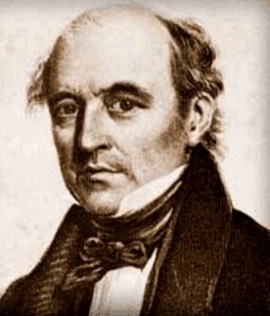
English botanist and explorer Allan Cunningham (1791 – 1839) worked in a solicitor's office before obtaining a position at Kew Gardens in 1808. This resulted in introductions to Joseph Banks and Robert Brown, who had sailed on the Investigator with Matthew Flinders.
After a plant collecting expedition in Brazil (1814-16), Cunningham sailed for Sydney on 28 September 1816. He arrived three months later and established himself at Parramatta before joining John Oxley's 1817 expedition to explore the Lachlan and Macquarie rivers. The 1900-kilometre journey saw him collect specimens of around 450 species and introduced him to the realities of Australian exploration.
Cunningham followed that with voyages to Australia's northwest coast as the ship's botanist with Philip Parker King aboard HMS Mermaid. The first voyage travelled via King George Sound, refreshed at Timor in June 1818, returned to Sydney at the end of July 1818, and saw Cunningham collect specimens of around three hundred species.
Excursions to the Illawarra region and Tasmania preceded a second voyage on the Mermaid, travelling to the northwest coast via Port Curtis, the Endeavour River and Torres Strait. After a second refreshment stop at Timor, the Mermaid was back in Sydney on 12 January 1820.
Bad weather forced the Mermaid back to Sydney for repairs at the start of King's third voyage in June. She suffered further damage after departing Sydney on 13 July. Following the northern course again, the Mermaid ran aground off Port Bowen on the 20th. After surveying the damage, King decided to continue the voyage rather than return to Sydney. However, by the time they reached the northwest coast in September, the hulls' condition forced them to spend ten days careening and carrying out other repairs. Still, they managed to avoid danger until they were almost back in Sydney. The Mermaid arrived there on 9 December after a close shave off Botany Bay.
With the unseaworthy Mermaid condemned, King's fourth voyage took the much larger Bathurst, which left Sydney on 26 May 1821 and again followed the northern route. After a diversion to Mauritius for a refit, they returned to the western coast at King George Sound on Christmas Eve. The stay there was long enough for Cunningham to make an extensive collection of plants. King then took the Bathurst back to Sydney by the northern route, arriving on 25 April 1822.
From there, King returned to England. Cunningham subsequently contributed A Few General Remarks On The Vegetation Of Certain Coasts Of Terra Australis, And More Especially Of Its North-Western Shores to King's two-volume Narrative Of A Survey Of The Intertropical And Western Coasts Of Australia (1825).
Cunningham continued collecting activities in the Blue Mountains (September 1822 - January 1823), recorded the excursion in a chapter for Barron Field's Geographical Memoirs on New South Wales (1825) and set out again.
A second 1823 expedition took him inside the Great Dividing Range, examining the Cudgegong and Goulburn Rivers and returning to Bathurst through the undeveloped Mudgee area in late June.
1824 expeditions saw Cunningham accompany John Oxley on his second expedition to Moreton Bay and carry out his own investigations of the area around modern-day Canberra.
After a trip to New Zealand (late August 1826 - January 1827), Cunningham began investigating the area west of the new Moreton Bay settlement. He travelled from the upper Hunter valley, crossed to the west of the Great Dividing Range, and identified the Darling Downs as an ideal area for settlement. Cunningham's Gap would open up the hinterland behind Moreton Bay.
Regulations prevented Cunningham from investigating the latter prospect. Still, two excursions from Brisbane the following year saw a route into the Darling Downs identified from the seaward side via the Logan River and Mount Lindsay. The first, where Commandant Patrick Logan focussed on the southern approaches towards Mount Warning and drew a blank. The second, travelling via Limestone (Ipswich), connected Moreton Bay with the Darling Downs through Spicer's and Cunningham's Gaps.
Had no overland route been found by Cunningham between the Upper Hunter River and Moreton Bay, the isolation of the Brisbane district would have left it open to the importation of criminals, just as Van Diemen's Land was left, and in all probability for as long a period. (Coote, Chapter 2)
However, that was the last of Cunningham's fieldwork.
While his official position as King's Collector prevented him from publishing works on botany, he went on to produce seven major papers and fifty-seven shorter papers. They covered taxonomy, geology, physical and botanical geography and zoology.
Australia's most prolific early 19th-century plant collector also produced numerous herbarium sheets: possibly as many as twenty thousand.
Cunningham returned to England in 1831 but was back in New South Wales as the government botanist in 1837. He resigned when he discovered that the position required him to grow vegetables for government officials.
He died of consumption in late June 1839.
During his own travels, and whilst sailing with Captain King, he had seen more of the continent than any man then living. (Favenc, Chapter III.)
His remains were reinterred in Sydney's Royal Botanic Gardens in 1901.
Sources:
Australian Dictionary of Biography
Michael Cannon, The Exploration of Australia: From First Voyages to Satellite Discoveries Sydney, Readers Digest Services, 1987
Manning Clark, A Short History of Australia, Camberwell, Penguin, 2006
William Coote, History of the Colony of Queensland, Volume I, Brisbane, William Thorne, 1882. Source: https://gutenberg.net.au/ebooks14/1400241h.html#ch-04
Raymond Evans, A History of Queensland Melbourne, Cambridge University Press 2007
Ernest Favenc, The History of Australian Exploration from 1788 to 1888. Complied from State Documents, Private Papers and the most authentic sources of information. Issued under the auspices of the Government of the Australian Colonies, Sydney, Turner and Henderson, 1888 (Project Gutenberg (Australia): https://gutenberg.net.au/ebooks03/0300101.txt)
Felipe Fernandez-Armesto (ed.) The Times Atlas of World Exploration, London, Harper Collins, 1991
W. Ross Johnston, Brisbane: The First Thirty Years, Brisbane, Booralong Publications, 1988
J. J. Knight, In the early days: history and incident of pioneer Queensland: with a dictionary of dates in chronological order, Brisbane. Sapsford, 1895